A New Framework for Shiatsu, Somatics, and the Therapeutic Relationship
In most contemporary approaches to physical health and bodywork, the underlying relationship between therapist and client has the same structure as a medical one. The therapist does a diagnosis and decides on a treatment in which the client is quite passive or at least follows the therapist’s instructions.
From the client’s point of view, the body is commonly perceived like an organic machine which is controlled by the mind. Sometimes it goes wrong, which means that it doesn’t do what the mind expects. Because of its complexity, most people feel that it needs the expertise of a therapist to fix the fault.
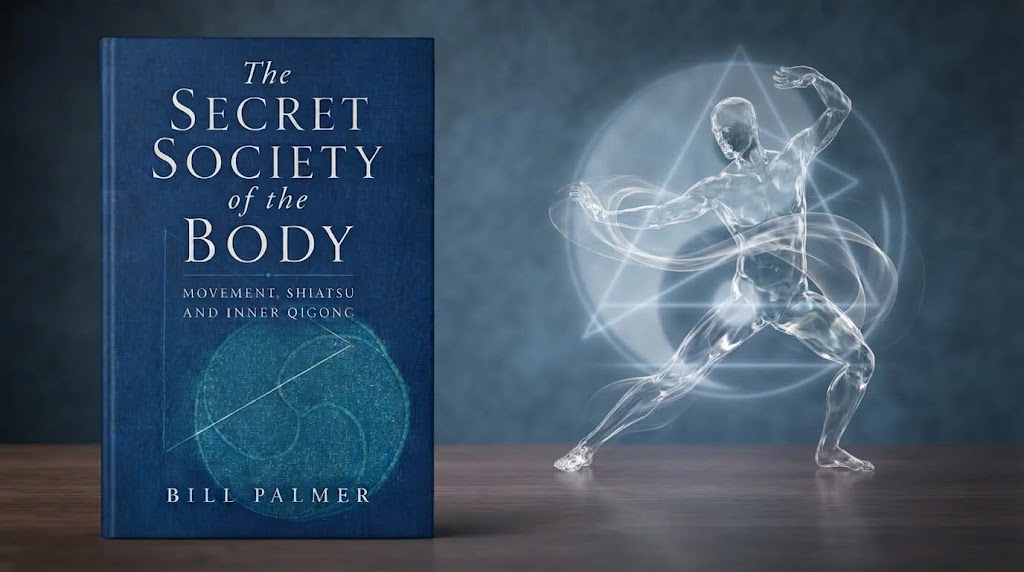
However, in chronic situations or when dealing with persistent patterns the problem is often not the symptomatic part but in the relationship that the mind has with the body. The body resists change because the mind is treating the body like a servant rather than including it in day to day and life decisions. This is the fundamental shift in perspective proposed by the book Secret Society of the Body written by Bill Palmer.
This book is an incredible journey. Firstly, because I’m aware that Bill was writing it for the last 26 years. So this is not a book. It is the result of a lifetime of work, reflection, experience and treatments. What I have always admired about Bill Palmer is the modernity of his approach. Having attended many of his courses, I have always been struck by his perspective on the positions of the patient and the therapist, his method of treating the body part by part to restore overall coherence, and his use of treatment in motion rather than keeping the body at rest, as is usually the case in Shiatsu. To put it simply: he is an iconoclast. I have identified four main topics from his book, which was published this September 2026.
Topic 1: The Inner Community — Moving Beyond the Illusion of Central Control
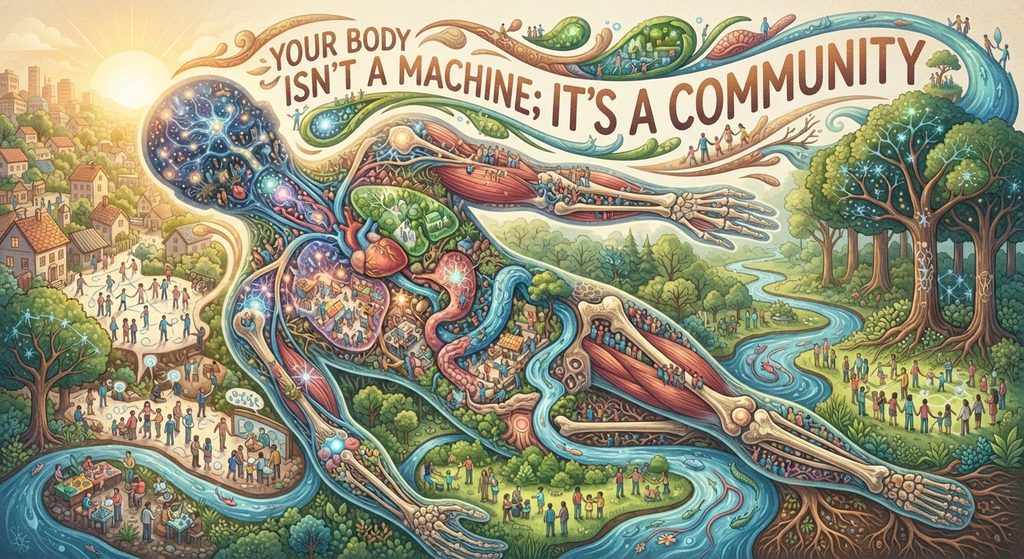
Instead of viewing the body as a passive mechanism governed by the brain, the book invites us to experience the body as a community of interdependent, intelligent agents. Bones, muscles, fascia, organs, cells, and physiological systems all actively participate in maintaining the life of the whole.
In this landscape, our everyday “ego”—the part that plans, explains, and tells the story of “me”—is not the absolute ruler of the system. It is simply one member among many within this inner community, particularly gifted with words, but without a monopoly on wisdom or solutions.
This view is more than a poetic metaphor. Contemporary biologists (notably Michael Levin’s research into cellular and organic intelligence) as well as philosophers of mind such as Iain McGilchrist are demonstrating today that tissues and cells display problem-solving, communication, and goal-directed organization without needing centralized control.
Topic 2: Qi as Body Intelligence
For many practitioners and laypeople alike, the East Asian concept of Qi has long oscillated between a mystical notion that is hard to prove and an abstract energy theory. The approach developed in Secret Society of the Body provides a fresh scientific and somatic insight: Qi is not a magical fluid, but the communicative intelligence of the body.
Science and traditional mindsets agree that all parts of the body communicate continuously through electrical, chemical, mechanical, and elastic signals. Energy itself is merely the physical carrier; what it carries is the organizational intelligence of life. It is this intelligence that Bill identifies with the Chinese concept of Qi rather than the energy that carries it.
From this perspective, meridians cease to be invisible energy channels to be manipulated: they become pathways of relationship and coordination. Treatment is no longer about forcing the flow of a fluid, but about restoring a broken dialogue within the inner community.
Topic 3: The Developmental Origin of Meridians and Movement
One of the book’s most original contributions lies in linking the functions of Qi (the Six Divisions in traditional medicine) with early infant motor development. Following Masunaga’s reflections and explanations on embryogenesis, this account by Bill Palmer seems to provide a logical continuation of human development. Personally, I love it!
Long before learning to speak or reason, a baby explores its world through spontaneous movement. It learns to establish boundaries, find support, initiate action, resolve conflicts, and structure its body without receiving top-down instructions from a central authority. Embryos and infants organize extraordinarily complex changes autonomously.
Bill has shown that the traditional meridians follow the exact pathways along which babies learn to connect and move their bodies. Later in life, somatic bodywork and movement experiments allow us to revisit these foundational pathways to reawaken areas that have become hidden, isolated, or overburdened.
Topic 4: Transforming the Therapeutic Stance and Embracing Vulnerability
This philosophy fundamentally redefines the role of the practitioner in Shiatsu, acupuncture, or other somatic therapies:
- From Mechanic to Facilitator: The practitioner is no longer the expert diagnosing a “fault” and applying a fix to a passive client. They become a guide who facilitates exploration and helps restart the client’s internal dialogue.
- The “Picnic” Metaphor: If a group is climbing a mountain and one member is injured, pushing on to reach the summit causes exhaustion, resentment, and shame. If the group changes plans and has a picnic instead, the injured person is no longer an obstacle. Similarly, when a body part suffers, the goal isn’t always to enforce an external standard of performance, but to adapt expectations and welcome the vulnerable part.
- From Inner Community to Outer Society: How we treat our bodies often mirrors how society treats vulnerability. A culture obsessed with high performance and perfection tends to push illness, aging, or disability out of sight. Learning to listen to the fragile members of our inner community is the first step toward building a more inclusive society that respects all living forms.
By combining East Asian medical philosophy, modern neuroscience, motor development, and the practice of Movement Shiatsu, The Secret Society of the Body offers a refreshing and deeply human framework. It reminds every practitioner and reader that health lies not in rigid control or mechanical repair, but in the richness of the conversations we cultivate with our own bodies. The book is also very practical, not just saying what we could do but also showing how to do it, including explorations linked into videos to transform the written word into lived experience. To put it simply, this book is a must-read!
Reference
‘Secret Society of the Body’, published by SEED, September 2026. More information and links to buying the book in your country on https://secretsocietyofthebody.com. Normal price £30.
Author
- Your Body isn’t a Machine; it’s a Community - 30 September 2026
- Can Shiatsu reduce anxiety in patients undergoing chemotherapy? - 15 August 2026
- Traditional Chinese Medicine for Shiatsu Practitioners and Other Complementary Health Therapists - 19 July 2026
- Zagreb: Abdominal massage Chinese (qineizang) and Japanese (anpuku) traditions – March, 19th-21st, 2027 with two specialists - 16 July 2026
- Italy: Between Heaven and Earth – An Immersion in Shiatsu and Taoist Philosophy, with Ivan Bel, June 9–13, 2027 - 16 July 2026
- Neck and stiffness in Shiatsu - 26 June 2026