
When I take some time to be still, for example during meditation or before falling asleep, that’s when it starts: A buzzing goes through my head, like a swarm of bees is flying through or a choir of crickets is giving a summer concert. This noise often doesn’t stop unless I distract myself.
What might a therapist or a friend say if you told them about this?
There are many possible reactions. Let’s look at some of them:
- This is tinnitus
- It increases with age.
- I know that, I have it all the time.
- There’s nothing you can do about it.
- It is not dangerous.
- Are you under a lot of stress at the moment?
- Do you often listen to a loud music?
- Do your ears hurt?
- You should relax.
B.
- And what kind of buzzing in the head is that?
- And where exactly is this buzzing in your head?
- And is there anything else about this buzzing in your head?
- And what happens before the buzzing starts?
- And what happens next?
- And this buzzing in your head is like what?
- And what would you like to happen?
The first set of reactions is probably more familiar to you from everyday life. It is about gathering information and organising it into a concept, giving advice and providing support. The therapist or friend takes the lead in the conversation, offering help, advice or comfort. In some contexts, this makes a lot of sense.
The second set of questions may seem strange at first. The questions are open-ended. They allow for a wide range of answers. They encourage the client to turn their attention away from the therapist and towards themselves in order to find their own personal answers. This type of questioning may seem unfamiliar or disappointing, especially if you are expecting concrete information and advice. However, there is enormous potential in this method and it is worth exploring.
What is Clean Language?
Clean Language is the name of this communication method used in therapy and coaching. New Zealander David Grove developed it in the 1980s while working with traumatised people. He noticed that they often found it difficult to put into words what they had experienced or what was going on inside them and that they often intuitively turned to metaphors and symbols to describe what they had experienced. David Grove began to use gentle, open-ended questions to pick up on these metaphors and explore them together with his patients on the level of images. In doing so, he opened up a safe space in which they could explore the deeper and more personal meaning of these metaphors. This was amazingly successful.
Over time, he developed a system of some 12 basic questions that take the therapist’s attitudes, concepts and hypotheses out of the equation as much as possible and allow the client to discover their own insights and solutions without being influenced. “Clean” itself is also a metaphor referring to the fact that the conversation is free from “contamination” by the therapist’s perspective.
Clean Language in Bodywork
Nick Pole, a British mind-body therapist and shiatsu teacher, deserves much credit for introducing Clean Language into bodywork. He offers international training courses on the subject and published the book “Words that Touch” in 2017, which is also available in German under the title “Worte, die berühren”. In his book, Nick Pole demonstrates the benefits of Clean Language for bodywork in a practical way and with clear examples.
What is the Core of Clean Language?
The basis of Clean Language, as I understand it, is the special attitude of the therapist: an attitude of mindfulness, of full attention, observing what is happening from moment to moment, as it is, without interpreting or judging, without any intention of influencing what is happening. This mindfulness is characterised by acceptance, compassion, genuine interest and equanimity. It shows great respect for the client’s world view and a natural trust in their ability to find solutions. This attitude leads almost automatically to the design of dialogue situations in the form of Clean Language:
In a Clean Language conversation, the therapist withholds their own interpretations, suggestions and impulses. They simply reproduce the other person’s words as accurately as possible and, if necessary, the manner of emphasis or gestures so that the other person can perceive them more accurately as if in a mirror. And open-ended questions that do not expect a specific answer stimulate chains of association that can lead to new insights.

Examples of such questions are
- “And is there anything else about X?”, where X is filled in with what the interviewee has previously said, for example: “And is there anything else about this pressure in your stomach?”
- Questions such as “And what kind of X is X?” or “And X is like what?” can encourage people to use metaphors and images to express what they want to say, especially when words are lacking. Metaphors and images hide so many facets of an issue at once.
A Practical Example
To illustrate what Clean Language can look like in practice, here is an abridged extract from a conversation with a client.
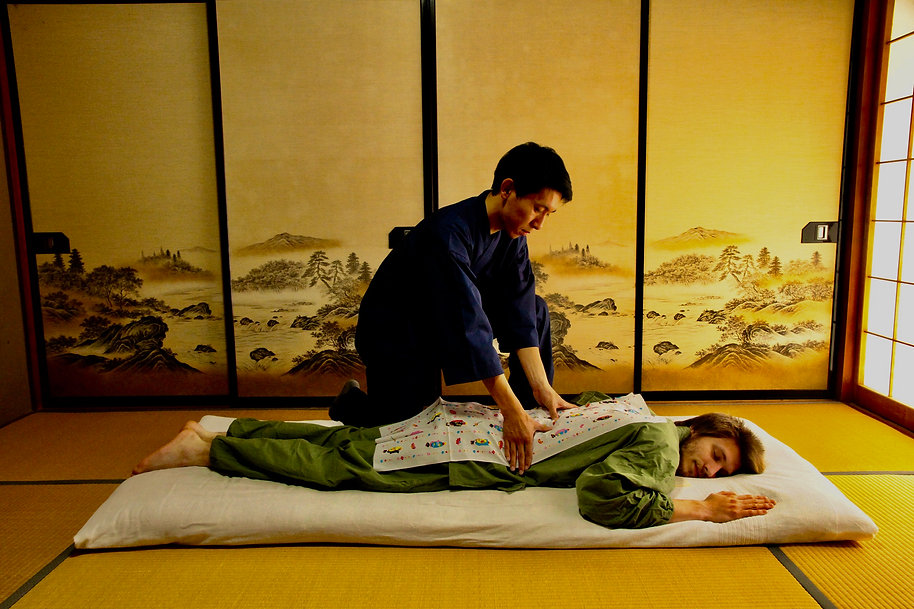
The client tells me that she finds it difficult to express her feelings, especially to her partner. Before we begin a shiatsu treatment, I invite her to focus her attention on the inside of her body and to feel which area of the body might need special attention and whether the problem might be reflected somewhere in the body.
- Client: “I feel a pressure in my throat.”
- Me: “And where exactly is this pressure?”
- Client: “More in the front.”
- Me: “And this pressure more in the front of your throat is like what?”
- Client: “Like a ball.”
- Me: “And is there anything else about this ball in the front of your throat?”
- Client: “It‘s stuck.”
- Me: “And is there anything else about ‘it’s stuck’?”
- Client: “Nothing comes out.”
- Me: “Nothing’s comes out. And is there anything else about ‘Nothing comes out’?”
- Client: “Then I won’t tell my secrets and won’t hurt anyone.”
- Me: “Then you won’t tell your secrets and you won’t hurt anyone. And is there anything else about ‘nothing comes out’?”
- Client: “Somehow I can’t say what I want to say.”
- Me: “And if you somehow can’t say what you want to say, what would you like to have happen?
- Client: “For the ball to move.”
- Me: “And what does the ball need so that it can move?”
- Client: “You’d have to pour oil on it.”
- Me: “And what would the ball like to have happen?”
- Client: “It wants to jump.”
- Me: “And if the ball can jump, what happens next?”
- Client: “Then I can alternate between expressing myself freely and closing myself off.”
- Me: “And how would that be?”
- Client: “I can breathe better.”
- Me: “And if you can alternate between expressing yourself freely and closing yourself off and breathe better, what happens to the pressure in your throat?”
- Client: “It’s softer and the ball has colourful polka dots.”
- Me: “And what do you know about all this now?”
- Client: “I can move the ball myself. And this humour and lightness helps me move forward.”
- Me: “And what difference does it make to know all that?”
- Client: “I feel that I have more influence. And I take the humour with me!”
- Me: And is this a good time to start the shiatsu treatment?”
Principles of Clean Language
Perhaps this brief example illustrates the key points of this method of communication:
Exact mirroring: I mirror the client’s words and gestures as accurately as possible. I do not paraphrase them or summarise them in my own words, as this would be coloured by my own point of view. This has to be done very carefully and minimalistically. It is easy to run the risk of sounding mechanistic and parrot-like. That would quickly break the contact. Sometimes a simple “Oh” or “Yes” is enough
Attention to body sensations: I always invite to pay attention to the sensations in your body. The body knows more about the issue at hand than we realise.
Include metaphors and symbols: Metaphors, images and symbols are closer to consciousness than physical sensations. I therefore ask whether a symbol might emerge for the bodily sensation or the theme, the various facets of which we can then look at more closely. Again, the metaphor is the client’s metaphor with its own individual meaning. We would do well to support them in exploring its meaning without offering our own associations to the metaphor, which may not really fit.
Open questions: The questions are open-ended and do not lead in any particular direction. They usually follow the wording suggested by David Grove to avoid being influenced by your own nuances.
Anchoring the experience: Closing questions such as “And what do you know about all this now?” help to anchor and consolidate the experience.
Author

- Clean Language in Bodywork – part 1 - 13 April 2026
- Do you know my mother? Shiatsu for people with complex disabilities - 12 January 2026