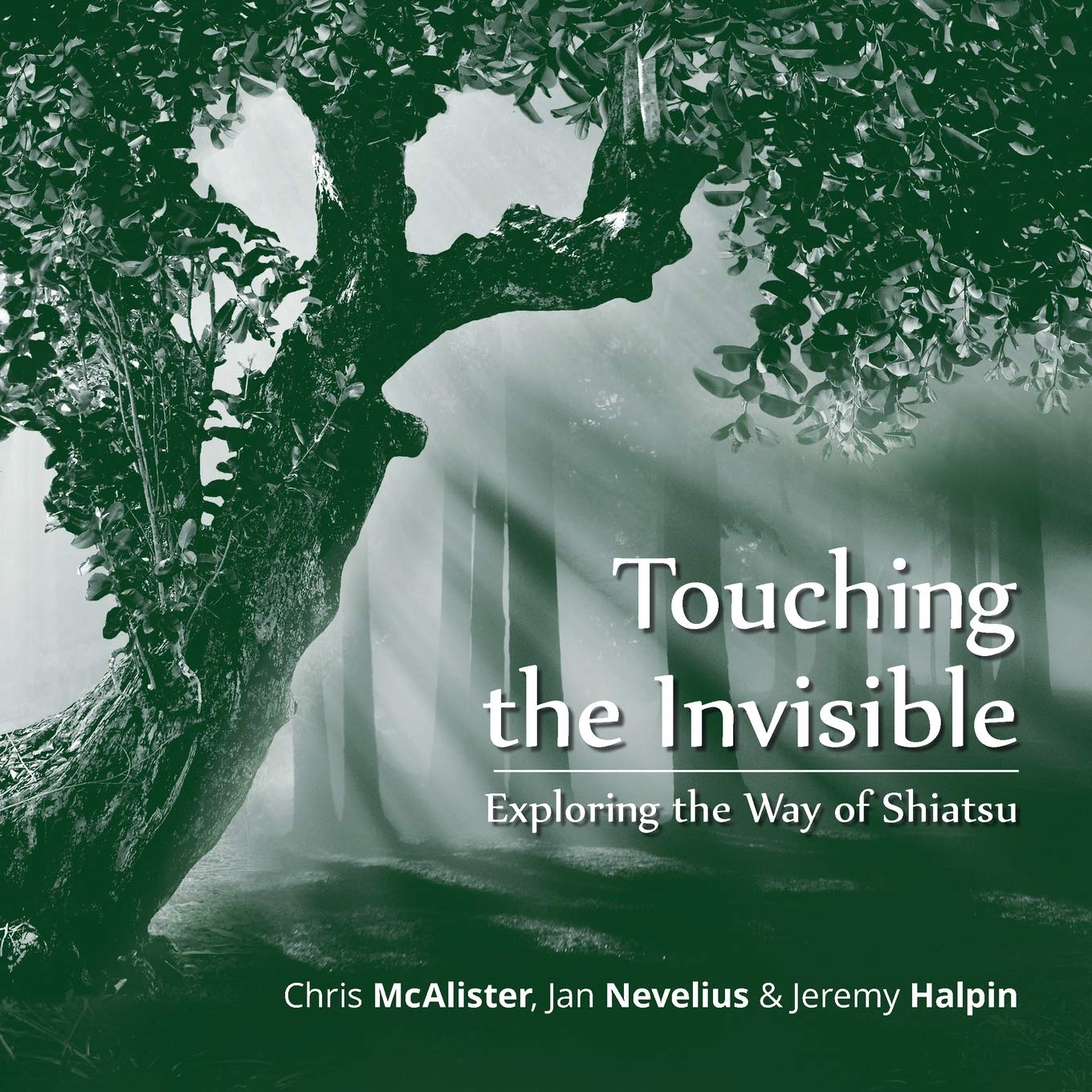
You have no doubt heard a lot about the book “Touching the Invisible – exploring the Way of Shiatsu” by Chris McAlister, Jan Nevelius, and Jeremy Halpin. There have been numerous posts and a few articles about it online. Although I received it some time ago, I make it a point of honour never to talk about a book until I have read every line, hence my delay in reviewing it. Never mind, that doesn’t detract from the pleasure, and I must say that I really enjoyed it, both for its content and for the quality of the writing. This is not a traditional book, but the result of numerous interviews in which the three authors open up and discuss all kinds of aspects of Shiatsu. As you can see, this is far from a technical book. And that’s what’s so good about it!
Published in English, this book discusses Shiatsu from a philosophical, ethical, emotional, professional, and theoretical perspective. It is this combination that makes it truly interesting. We are not limited to a single aspect, as is often the case with technical books. Here, most of the major underlying themes are addressed. Nor is it a course explaining what Shiatsu is, but rather how it is approached by the three authors, in their own words. Of course, to aid understanding, there are sections and subheadings, but it is still not a textbook. On the other hand, it is a great resource for nourishing our thinking about Shiatsu.
Certain topics are well-known classics among shiatsushi practitioners. What is Qi, Yin/Yang, Kyo/Jitsu, the five elements, Hara. But the authors take us further by questioning the role of the practitioner and the patient, and what it means to treat with Shiatsu. I particularly liked the last chapters on the present and future of this manual therapeutic art. Or what are the steps and conditions for successful treatment. This book does not discuss technique, but—as you will understand—concepts, principles, and conditions. Let’s take an example. What is the difference between curing and healing? This is Jan’s answer:
“That depends on our definition of healing and curing. In Western medicine, ‘cure’ is used to signify that the symptoms are gone — a headache is deemed to be cured when it is not felt any more. This does not mean that it is healed on a deeper level however — in all likelihood, the cause of the headache has not been addressed.”
And Jeremy adds:
“Shiatsu takes a different view from Western medicine as to what defines ahealing and curing. An abatement or repressionof a symptom pattern through medication is often considered a cure in conventional medicine. For a client to say, ‘I’m OK as long as I keep taking my pills’ does not qualify as healing in Shiatsu and may well lead to the creationof other problems.”
We totally agree!
But to believe that the debate in this chapter on the nature of care revolves around this question would be to misunderstand the depth of this book. Everything is explained in depth, and the subchapters are eloquent in this regard:
- What are the internal and external aspects of healing?
- Awakening innate healing energies
- Intuition in healing
- Consciousness and healing
- Healing vs curing
- The signs of healing
- Time and healing process
- The range of outcomes in the healing process
- Preconceived ideas about healing
- Layers within the healing process
- Constant learning
The least we can say is that the discussion is thorough and leaves few areas unexplored. And the same goes for each chapter. The result is that the three authors of this book invite us on a journey, encouraging us to question and reflect.
I have only one criticism of this book: its size. It is too big to carry around easily, which is a shame. A book of reflections is usually the kind of book you like to put in your bag and dip into here and there, preferably while out for a walk. A bit like the philosophers’ books of thoughts, in a way. As a result, you are forced to read it at home, quietly, sitting in a comfortable armchair by the fireplace, which isn’t a bad thing either.
I have not yet introduced the authors, who are not newcomers to the world of Shiatsu, but experienced teachers and practitioners.
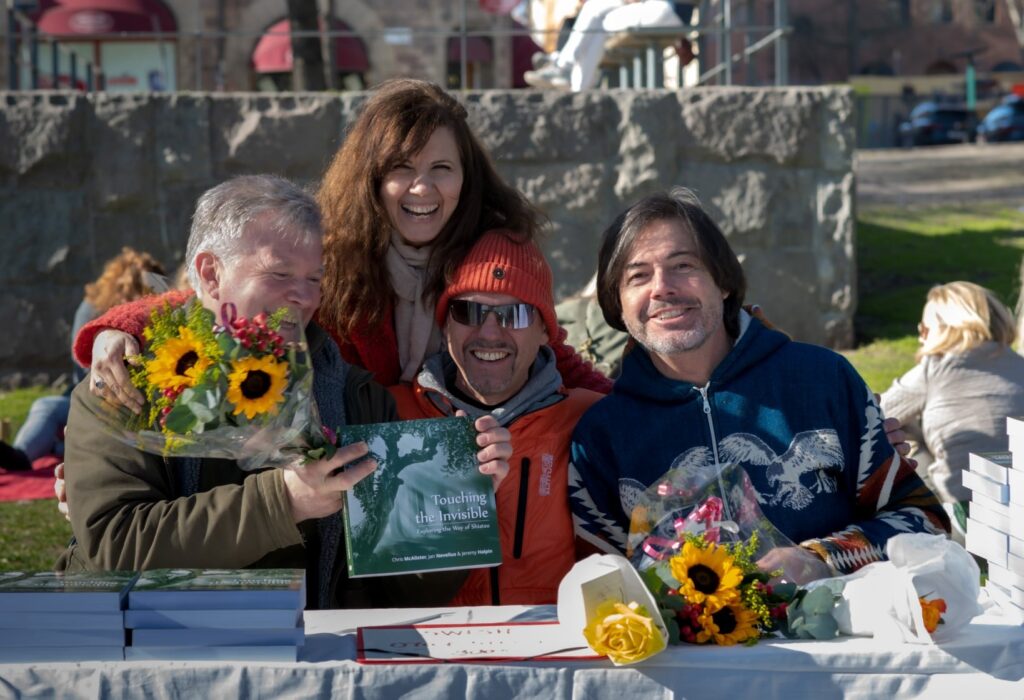
Chris McAlister was the president of the European Shiatsu Federation (ESF) and the European Federation for Complementary Medicine (EFCAM), but he is also a teacher, a practitioner, and a great connoisseur of Asian arts, particularly martial arts and spirituality. Originally from England, he now lives in Sweden.
Jeremy Halpin is Australian. He too has been a Shiatsu specialist for 35 years, both as a teacher and practitioner. Between 2000 and 2008, he was a researcher in complementary and alternative medicine (CAM) and a lecturer on complementary medicine for doctors and medical students at the Karolinska Institute in Stockholm.
I have particularly taken to Jan Nevelius, whom I didn’t know before. He has 40 years of experience practicing Shiatsu and holds a 7th dan in Aikido. He also teaches Reiki and Qigong.
In conclusion, we can only rejoice that such a book exists, as it offers insights for every level. Beginners, students, practitioners, and teachers will all find something to enrich them intellectually. We can only rejoice at the collaboration of these three musketeers of Shiatsu, who open up debate and understanding of our art. I therefore recommend that this book take its place alongside “The Fifth Season” as our only books reflection on Shiatsu today… until the next one comes along.
Author
- USA: 3rd Annual Shiatsu Summit – April 17/19, 2026 - 26 January 2026
- 2nd Balkans Shiatsu Summit – in Zagreb (Croatia), April 11 & 12, 2026 - 11 January 2026
- Belgium: depression and burn-out with Shiatsu – June 19-21, 2026 in Ostend - 7 January 2026
- An intensive week to explore Emotions and Psychological Disorders – 5-11 July 2026 - 6 January 2026
- Switzerland: Workshop for all levels on the principles and concepts of Shiatsu – October 16–18, 2026 - 10 December 2025
- FAQs - 12 August 2025
Translator
Her interest in caring for others led her to become a nurse, graduating in 2005. She works in adult surgical wards. She discovered shiatsu in 2014, after a complicated pregnancy and birth, shiatsu relieved the anxieties of her 3-month-old son. She began training at ITMTC Amiens in 2016, graduating in 2019.
Along with her job as a nurse, she opened her shiatsu practice and continues to learn with, among others, Ivan Bel.