About fifteen years ago, I received a special gift. The director of a workshop for disabled people called me to ask if I would be willing to give two and a half hours of Shiatsu treatment per week at her facility. The colleague who had previously performed this task had unfortunately stopped, and she was now looking for a replacement. One of my Shiatsu students had recommended me to them. I asked for a little time to think about it – and then accepted. Since then, I have been going there every Tuesday.
(All names and photos are published with the explicit consent of the individuals concerned or their legal guardians.)
Arriving in another world
The first few weeks were challenging. The people who were brought – or pushed – into the treatment room bore little resemblance to the clients who book appointments at my practice. Many were confined to wheelchairs and could not be transferred to a treatment table or mat in the time available. One person could walk, but he could not see, speak or hear. For weeks, he refused to sit down, let alone lie down. He just stood in the middle of the room and waved his arms wildly.
Several people exhibited pronounced autistic behaviour. If you touched them, they would panic. Some only entered the treatment room for a few minutes, if at all.
How was I supposed to apply everything I had learned in my shiatsu training? Diagnosis? Targeted meridian work? Rotations and stretches…?
Then, I remembered an attitude I had acquired during decades of work at a special school:
Acknowledge what is.
Instead of deriving goals from concepts or what should be, they should be derived from what the situation allows. Then pursue these goals with patience and flexible perseverance.
In this article I will, based on three encounters, describe how this attitude has proven itself, how I came across an important core of Shiatsu in this work, and how much this has transformed my practice.
Three stories
Günter
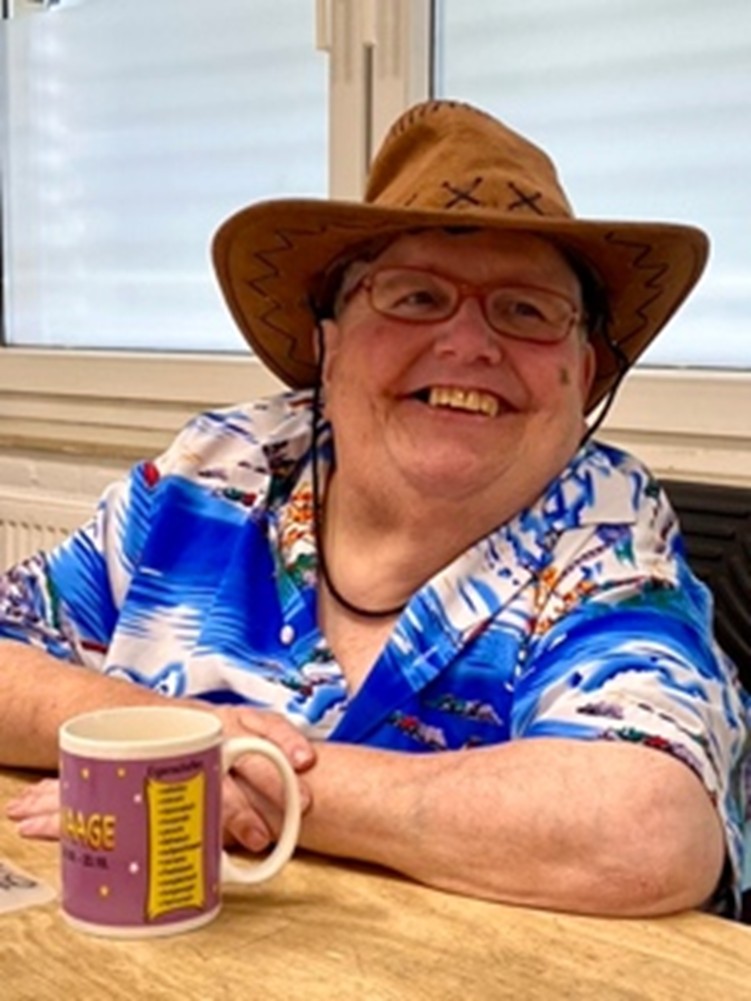
I have known Günter for many years. He is in his early sixties, very short, very corpulent and severely disabled. He rarely moves from his chair. Sometimes he pushes his rollator walker down the corridors with great effort. Despite his circumstances, Günter radiates cheerfulness and is passionate about calendar dates and the weather. He often sits in the hallway and asks everyone who passes by whether Christmas, Carnival or Easter is coming soon. Or if it will rain today.
When asked what he did during the weekend or what he had for lunch, he usually replies “I don’t know.“
For a long time, there was no opportunity to give Günter a Shiatsu treatment. That changed about two years ago. I happened to be sitting next to him and asked if I could show him what I could do with my hands, that it was called Shiatsu. He nodded.
I put my hands on his upper arm and gently pressed a few points. Finally, I put my arm around his shoulder and sat quietly. Günter didn’t say a word, which was unusual for him. Eventually, he asked:
“Do you know my mother?“
“Yes,“I replied. “I saw you together once in an ice cream parlour.“
“She’s dead,” he explained. She had passed away a year ago.
I nodded. We sat next to each other in silence for a while. Then I asked him if I could come back the following Tuesday.
“Yes“, he replied.
Over the next few days, he kept asking his carer when the woman would be coming back.
“Which woman?“
“The one with the arm.“
Since then, Günter has been waiting for me every Tuesday. His arms want attention, sometimes his back or legs do too. He now particularly enjoys having his hands treated or simply held quietly. After about ten minutes it’s enough.
The words of Tokujirō Namikoshi often accompany me in these moments: “The heart of Shiatsu is the heart of a mother.”
Sascha
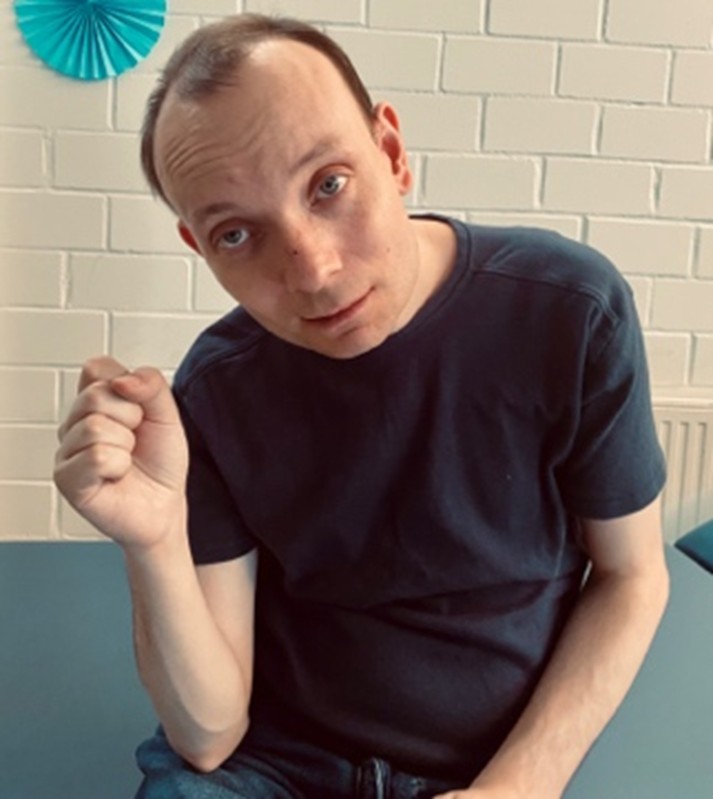
I have worked with Sascha for about ten years. He is in his mid-30s, tall and slim, and has pronounced scoliosis. He is autistic. He can walk, see, hear and speak – but he avoids eye contact and instead looks to the side with his large eyes in a rather absent-minded manner. His speech often consists of only a few, repetitive sentences:
“There’s no power cut today.“
“The schooldays are over.“
“We’ll go back soon.“
“Leave again” said Sascha after two minutes of our first Shiatsu encounter. So we left.
I took him back to his work area. The following week, I picked him up again and brought him to the treatment room, where he sat down on the treatment table (of course he didn’t lie down, especially not on a mat on the floor), and I treated his hands. After three minutes, he asked me to take him back.
In the weeks that followed, our meetings always followed a similar pattern. I would pick him up, he would undergo a brief treatment on his hands, and then he would want to go back. However, something was happening – slowly – that might become apparent if we fast forward ten years.
Today, Sascha comes straight to me as soon as I walk through the door. He smiles, takes me by the hand and says clearly: “Shiatsu.” He has been waiting for this all morning. In the treatment room, he sits down and holds out his hands for me to treat. Now he can say where he would like to be treated next. Usually it’s his back. His gaze wanders around the room. Every now and then he makes eye contact, and we smile at each other.
We now spend fifteen minutes or more together. When we meet in the corridor later, he says: “Shiatsu was nice.“
Duc
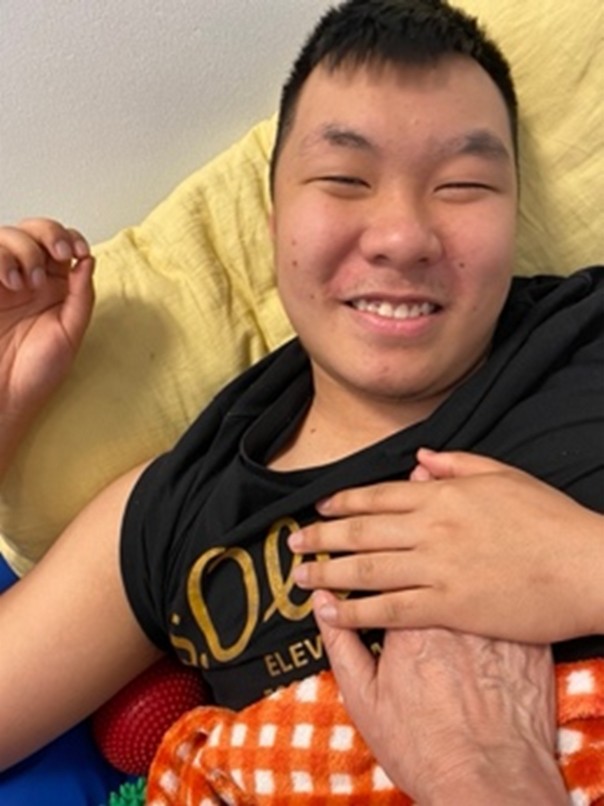
Duc is a young man in his twenties from a Vietnamese family. I have known him for over a year. He does not consider language as his means of communication. He hardly speaks, but he understands a lot.
During the first few weeks, he didn’t want any contact, not even eye contact. Initially, I was only allowed to sit a short distance away and watch him do puzzles. Later, I was allowed to help him a little. The first breakthrough came when we rolled a spiky massage ball back and forth. This developed into a simple ball game that we played for weeks. At some point, I was allowed to roll the ball over his hands – and finally work with him directly. He looked at me very reverently as I did so.
Now, a few months later, Duc still waits for me every Tuesday. A lot has changed in the meantime. He always reaches out his hands to me first and enjoys the treatment. Then he often pulls me towards him, takes my hands and places them on either side of his face, beaming all the while. He especially loves it when my fingers glide along the edge of his skull and finally come to rest at the point called “Window of Heaven” (SJ 16).
Our encounters never last longer than twenty minutes. Duc clearly shows me when he has had enough. When we part, he waves and often takes my two hands in his, touching his forehead with them, a gesture he has probably learned from his family.
What a journey we have been on!
What does Shiatsu mean in this context?
For many of the people I work with in the workshop, Shiatsu is above all a welcome break from their often monotonous daily routine.
The carers in particular want the people I treat to experience relaxation. Some suffer from back pain due to permanent poor posture. Many of them are under high stress, either temporarily or permanently, which is immediately noticeable when they are touched and is also reflected in their behaviour. Some talk constantly, often saying the same thing over and over, while others gesticulate or make stereotypical movements or sounds. Even very simple Shiatsu touches and the calmness I bring along can provide relaxation through co-regulation here.
Touch in Shiatsu differs significantly from touch in nursing, physiotherapy or basal stimulation. Although there are overlaps, Shiatsu has its own unique quality. It is more energetic than physical, focusing less on a specific area of the body and more on the person as a whole. At least in the way that I practise Shiatsu in this context, it does not follow any particular concept or goal. The direction is determined by the situation, the resonance and the moment.
Many can experience: No one here wants to fix me. I am not wrong. I am okay just as I am, and I am accepted.
And: “Man becomes an I through a Thou” says philosopher Martin Buber. Through a present, loving counterpart whose attention is also physically felt through touch, it becomes easier for the person being treated to perceive themselves in their fullness, dignity and beauty.
The attitude of the practitioner
Not-knowing, respect, being with what is, vertical and mindful pressure, self-care… In my view, these basic attitudes are essential for every Shiatsu treatment. This is particularly true when treating people with disabilities.
Not-knowing in this context means that we are even less able than usual to truly empathise with others. We can only guess what it might be like to sit almost motionless in a wheelchair for your entire life, to have very limited contact with others, to only understand the world in fragments and to have little control over what happens to you. We can get an idea if we are able to resonate, to feel a resonance beyond concepts. Then we may be able to intuitively touch people in the way they need at that moment.
Respect and dignity mean recognising a person’s potential rather than viewing them primarily as deficient. Respect means seeing and treating them as fundamentally equal, not patronising them but supporting them where they really need help. It also means acknowledging the suffering that comes with disability, without belittling it or succumbing to the illusion that it is in our power to change it.
Accepting what is – or what is not. Much of what we take for granted in Shiatsu falls away, while other things are added. For example, we cannot assume that the person we want to treat is able or willing to lie down on a mat or treatment table. Often, we have to treat them in their wheelchair. And some who can actually move around normally do not want to leave their chair in their work area. Their familiar surroundings give them a sense of security, and for some, lying down can mean giving up what little control they have left over their lives. So I treat them in their chair, amidst the hustle and bustle of everyday life. And being with what is means, in this case, incorporating the current moods and needs, that people with disabilities often express more openly, into the treatment. This can mean, for example, that someone simply doesn’t feel like Shiatsu that day, that he or she would rather walk down the corridor with me or tell me something. It may also mean that someone is so restless that all I can do is to simply sit quietly next to them.
I remember Markus, whose father had recently died. For months, he waited for me every Tuesday, just to tell me about the event over and over again and ask the same questions. Shiatsu, as we know it, played no role. I just sat with him, listened and held his hand until he calmed down and asked for his cappuccino. Here, Shiatsu was purely a matter of resonance, beyond any techniques. It requires exactly that from the practitioner: to enter into a silent resonance with what is happening in that moment, without wanting to achieve anything.
Practical tips
Start with the hands and feet
I start almost every treatment in the workshop on the hands and, sometimes, the feet. There are several reasons for this. The hands and feet are usually easily accessible, even when working with someone in a wheelchair. In addition, all meridians begin or end there, enabling me to address the whole person through seemingly peripheral work.
Another aspect that should not be underestimated is that even people who tend to shy away from physical contact or are easily overwhelmed can often accept touch away from the centre of the body. Working on the hands and feet provides a sense of security and direction, and often forms the basis for everything else.
Indirect work
Individuals on the autism spectrum and particularly those who have experienced trauma, often react with significant resistance to direct touch, at least initially. In these cases, indirect work has proven to be a very effective approach. For example, a thick blanket can create an initial protective distance between my hands and the body. Small sandbags can also be used instead of my hands to apply pressure. Many also enjoy having a spiky ball used on them.
A ball can serve as a mediating medium during the initial contact, rolling it back and forth without touching the person directly. Touch then occurs more casually, seemingly by chance, and is therefore often more easily accepted.
Always the same procedures
The more insecure and inflexible a person is, the more important clarity and predictability become. Especially when working with cognitively impaired people, I find it very helpful to keep the sequence of a Shiatsu treatment as consistent as possible.
For example, I always start with the hands, then the arms, and later, when more is possible, I move on to the legs and feet, and possibly the back at the end. In this context, a clear, recurring sequence is often more helpful than a process-oriented treatment based on an energetic assessment. This is because the focus is less on targeted meridian work and more on resonance and the quality of touch.
Closely related to this are reliability and regularity. I make a point of coming every Tuesday and very rarely miss appointments. This continuity creates trust, which is an essential part of the effect for many people.
Short sessions
Most of the people with disabilities that I work with have a fairly short attention span. They thoroughly enjoy the treatment and have often been looking forward to it all week, but usually signal after 10-30 minutes that they have had enough.
Rather than seeing this time limit as a restriction, I see it as an invitation. The shorter the session, the more focused the touch should be. Often, within just a few minutes, exactly what is possible and meaningful unfolds.
Going along with stereotypes
This approach is well known in psychotherapy: the therapist picks up on the speed, rhythm and energy of the client’s movements or speech and mirrors them. Statements are often repeated verbatim.
While mirroring can be helpful for people with disabilities, it can also be particularly challenging for the practitioner. It is really not easy to engage with stereotypical movements such as rocking or waving your arms around, or to hear the same question or statement for what feels like the hundredth time, such as: “Is there a power cut today?” or “Murat is in the hospital.”
However, it is precisely this mirroring that helps the other person to perceive themselves and feel that they are being taken seriously. Only then stereotypes can sometimes change, soften or come to rest for a moment.
Spreading the word
I myself only give two and a half hours of Shiatsu a week at the workshop for disabled people, a drop in the ocean, one might think. This is why it is so important to me to convey the essence of what Shiatsu is all about to the carers and relatives: the importance of touch, its special quality, the non-intentionality, the resonance, the calm, the encounter “from my heart to your heart“.
Part of this happens quite incidentally, as the carers observe me in my everyday work. Occasionally, if they wish, I give them short treatment sessions so that they can experience for themselves what it is all about. I am also very happy to show them simple treatment procedures in workshops that they can integrate into their everyday lives. There is usually not enough time or financial resources for more extensive courses, but even small impulses can have a big impact.
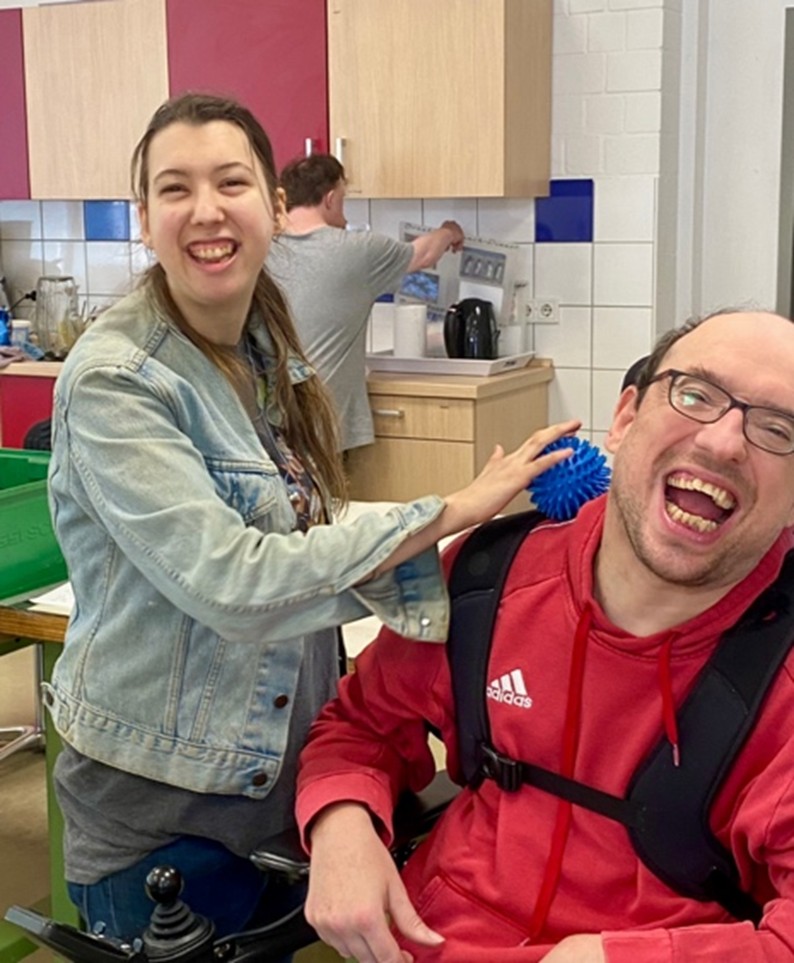
And I also show simple treatment steps to some of the people I work with, for example on the hands or back, sometimes just using a spiky ball. This enables them to do something good for each other. Thus, my work can have a snowball effect.
Yvonne, who is in one of the groups, is now my ‘assistant’ and provides other group members or their carers with short treatments when I am not there. This brings great joy to more than just her.
“If you want to build a ship, don’t drum up people to collect wood and assign tasks and work, but rather teach them to long for the vast endless sea.”
Antoine de Saint-Exupéry
Author
- Do you know my mother? Shiatsu for people with complex disabilities - 12 January 2026
Translator